|
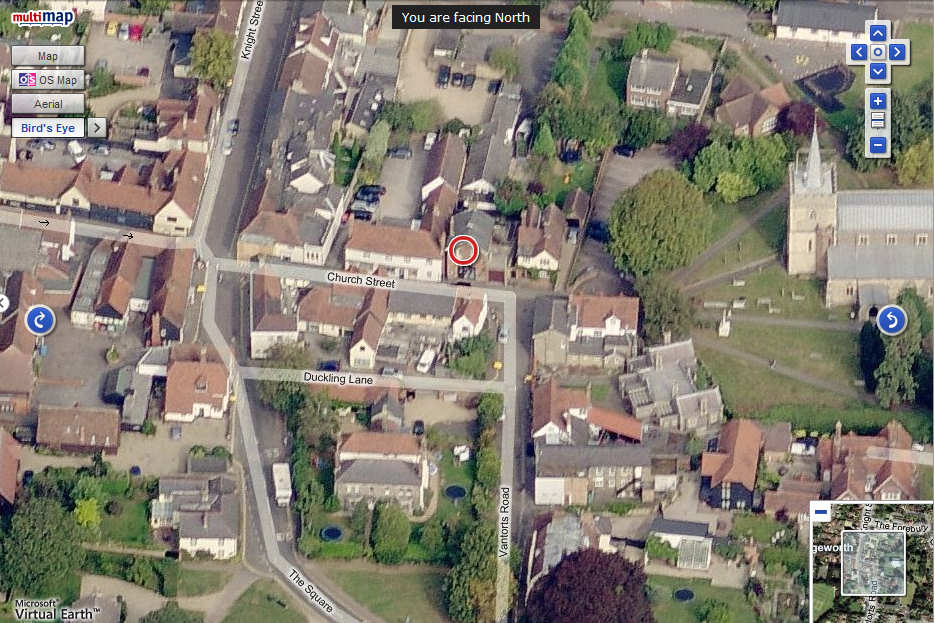
Sawbridgeworth Fire Brigade - The Fire Station |
|
[Fire
Station on the Map] [Birds
Eye View ] |
|
Page last updated:
13/01/2023 |
| Paragraph Headings |
|
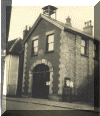
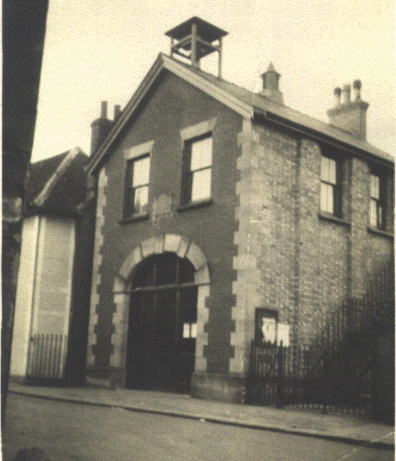
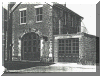
The Original Building - official opening 4th April 1906 -
taken out of service March 17th 1981.
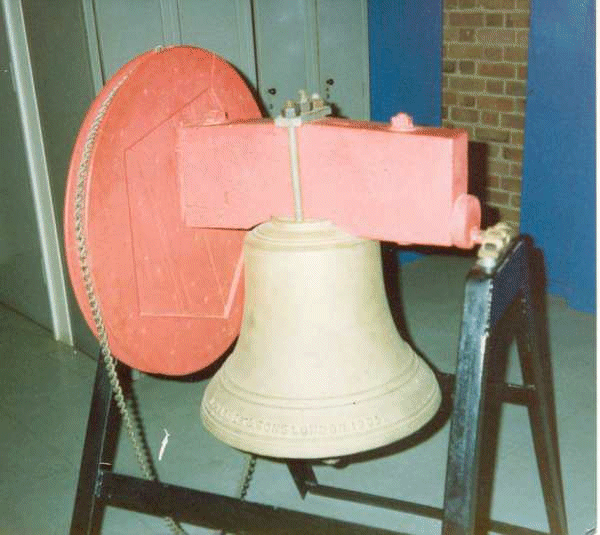
The bell tower is clearly
visible.
This
picture, probably taken in the 1920's, shows the Fire Station in Church
Street as it was in 1905-6 when it was built and the external iron staircase
to the East side that in the early 1940's was moved and rebuilt to the rear to enable
a single storey side extension to be built for a second/third appliance. The
notice board on the side was undoubtedly related to the Council Offices
which the external staircase led to. The first floor rooms were integrated
with the fire station after the Council Offices moved to new premises in The Forebury. The picture is taken from an angle which just shows the edge of
one of the pair of cottages that were on the corner of Vantorts Road and
Church Street making the road very narrow in width to the Church House. The
only reason that the
Ford Water Tender
could be housed in the extension was
the absence of these cottages, as with a Trailer Pump on tow it was almost
impossible to turn out of the Station into Church Street. Turnouts were
always over the rough unmade-up area of the cottages and past the King William IV,
except when the two annual fairs closed off the Fair Green and Ducklings
Lane. Then the turnout
was a two part affair - the Water Tender first into Church Street then the
Trailer Pump manhandled and hitched.
When the Council
vacated the first floor an internal open 'trap' was formed in the floor of
the main appliance room, at the South East corner and a vertical ladder
fixed to the wall to give direct access from and to the fire station itself.
One of the reasons for the very basic ladder arrangement was to save space,
almost as soon as the fire station was completed it was found to be
restrictive in space because of the need to house a towing vehicle "tractor"(*) for the
steam fire engine. One remnant of the Steamer Fire Engine remained visible
to the end. The position of the one time ash pit for raking out the coal
fire always remained visible in the very middle of the station floor, where
the pit had been back filled and concreted over.
| (*) The, so
called, "tractor" was believed to be a Hudson Aeroplane open top type
vehicle, adopted for its well revered pulling power. It was still there at
the beginning of WWII and was used to tow a trailer pump, presumably the
Coventry Climax pump eventually hitched and towed by the N.F.S Austin TV.
This combination was still housed in the main fire station until the
extension was built and the N.F.S Austin Towing Vehicle was supplied. It is
not known what happened to the "tractor". |
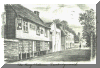 |
Originally the horses used to pull the fire engine had been housed in stables at the
rear of the side entrance to the King William IV
Public House in Vantorts Road (Top Left). Presumably the fire engine
itself (Manual and Steamer) was also housed there.
It is not known whether the horses were still in use when the
new fire station came into use. The integration of the first
floor rooms proper was not fully established until the late
1940's or even early 1950's. At this time a wooden staircase was
fitted and the 'trap' and ladder removed.
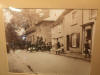
The picture (Bottom Left) was found displayed in the
George IV public house in Knight Street in 2016. The date is
unknown but this could be prior to 1906 when the Church Street
Fire Station was officially opened and is endorsed as the
brigade turning out with the horses and from presumably its
then 'home' at the King William IV Public House. |
 |
|
|
|
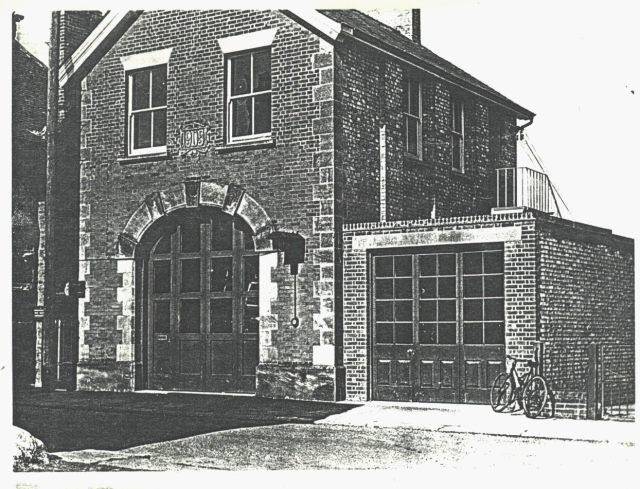
Enlargement For War.
By
the time of this picture the main doors had been extended to open to the
full arch. Also note the large stone against the remaining cottage to
prevent vehicles, especially fire engines, hitting the wall! (see
Ford Water Tender above)
The addition bay to the East side
was built very early in the war, one can only presume at the behest of the
National Fire Service and I can in fact just recall it being built. As well
as the front doors shown in the picture, corresponding plain doors were also
at the rear, leading out to the back yard with the Hose Tower, topped by the
Siren in the war and afterwards. This addition was only built to a height
suitable to house the type of war time appliances of the time. The height
was later to preclude the brigade of a more modern upgrading of appliance -
in the early days of Hertfordshire Fire Brigade they 'struggled' to
fit an appliance with a Wheeled Escape into either bay without success! This
could have prolonged the life of the 1935 Leyland appliance but Bishop's
Stortford's (black) Leyland was eventually converted and fitted with the
Wheeled Escape Ladder to
cover the fire cover area.
This addition was augmented by
other alterations. The original one ground floor room at the rear of the
main building was split to create a Control Room plus two sets of ablutions,
male and female because of course women were now to be accommodated.
Upstairs on the first floor the main room at the front became a games /
training room and at the back, Northwest end, a kitchen was installed. The
other room at the back into which the iron staircase led became the bunk
room. I can remember this being full of bunk beds to sleep or rest those on
duty overnight during the war. |
|
|
|
The Back Yard Area.
The West side of the Control Room
back door lead immediately outside where to the left was a boiler house with
coke boiler and the original single toilet. The latter was always left
accessible (unlocked) so that the local Council Workers had toilet facilities. The
boiler was like most boilers of its day - if burning conditions were not
just right it had often gone out and usually still full of fuel! There were
many times when the place was freezing cold and no hot water - it took ages to raise the
temperature through the 2" circulation pipes and just three radiators in the
whole place, the Melton material heavy uniforms taking ages to dry or air!
The hose tower, used to dry wet
canvas hose after use or cleaning, was erected sometime in the late 1920's
but the only written record found is that of it being repainted in 1938 by
the firemen, subject to the Urban Council supplying the paint. The platform
on the top on which the siren was eventually mounted had a previous special
purpose. This platform was about 30' from the ground and made a very
suitable facility to practice rescue using the 35' extension ladder supplied
with the Leyland Cub Fire Appliance purchased in 1935. There was another
rather precarious platform under the main one so that there was somewhere to
stand to feed the hoses over the hose drying / hanging rails. The other way of
ascending the tower was using a vertical steel ladder fixed permanently to
the tower. The tower stood on a purposely constructed base of weather
resistant 'blue' Staffordshire bricks which drained to a centre drain to
release water from draining hoses. |
|
|
Other Buildings.
In theory there was always a back
entrance to the fire station yard but which was really the access to what
was the Sawbridgeworth Urban District Council yard. The gate to this yard
lead onto the rather narrow unmade driveway at the South side of the Fawbert
& Barnard School and then onto Knight Street. At about the time of the
building of the extension to the fire station a building was also erected at
this yard gateway entrance. This was for, at least initially, to house a
special vehicle used for testing gas masks. This was built during my first
year at school and I watched the progress from the school playground. At
about the same time I had my first experience of being subjected to a tear
gas test of my gas mask. There was never a defined boundary in the yard,
albeit it was usually accepted that the fire station yard ended at the North
end of the concrete area fronting the hose tower.
Looking North from the fire
station, other single storey buildings were down the left hand side and
possibly still remain. These were originally hastily erected at the start of
the second world war for the Air Raid Warden Post (ARP). The building
nearest the fire station had a separate entrance and was partly shared by
the fire brigade supposedly for extra storage but was put to excellent use
as a toy workshop early in the war. Fireman on night duty spent their free
time making wooden toys (mainly in plywood) for local evacuated children -
toys of course were hard to come by. Several of the fireman were employed at
Walter Lawrence Joinery so one can only assume the source of the wood.
|
|
The
4 Minute Warning!
 In the 'dark days' of the late
1950's and the threat of nuclear war the middle building of the ARP premises
contained a Black Telephone, similar to that left but with no dial. The fire station Control Room had
an identical one - these were for "the four minute warning" of attack. These
telephones if lifted had a very distinct repeating beep note at about two
second intervals to show that they were 'alive'. I think these were still in
place when I left the brigade in 1962! Worrying times! In the 'dark days' of the late
1950's and the threat of nuclear war the middle building of the ARP premises
contained a Black Telephone, similar to that left but with no dial. The fire station Control Room had
an identical one - these were for "the four minute warning" of attack. These
telephones if lifted had a very distinct repeating beep note at about two
second intervals to show that they were 'alive'. I think these were still in
place when I left the brigade in 1962! Worrying times!
| You can hear the beep by clicking the telephone
with your mouse! (Let
the file download to your 'player' then play it again to get the correct
timing! - File size 377kb) |
|

|
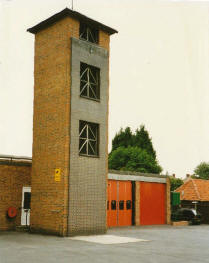 |
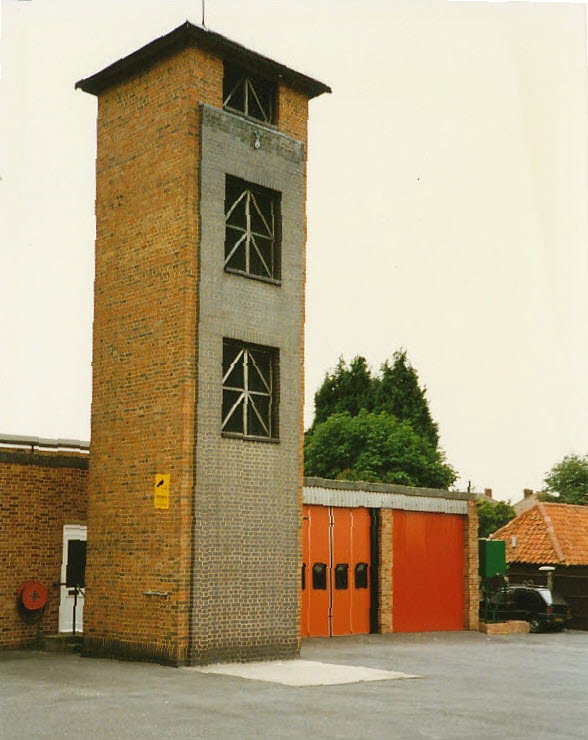
The
New
Fire Station (put into service 17th March
1981) that
was built in Station Road to replace the original in Church Street which is
now a Decorating Store. The Station Road site was previously the
Sawbridgeworth Urban District Council Road Repairs depot and earlier
was fronted by the Blacksmith's premises of W.
Hutley & Son, later E. (Ted) Hutley. Picture left
taken around 1998. |
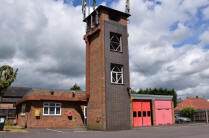 . . |
This photo taken in the spring 2016
shows the public access defibrillator installed outside
of the station for public use (accessed by dialling 999
for ambulance and if the ambulance service believe that
getting this defibrillator to the casualty would be
quicker than they can get an ambulance or first
responder there, they tell the caller to collect it and
provide the access code for the key pad). Other changes
since the earlier photo |
| indicate the windows have
been upgraded to UPVC. Also the front and side doors
have been upgraded from wood to aluminium style doors. A
UPVC window frame installed in tower is to aid more
realistic entry's into buildings. The Drill yard
re-tarmac provides a safer surface and new LED flood
lights illuminate the drill yard. |
|
|
1988 View |
|
 |
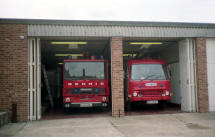 |
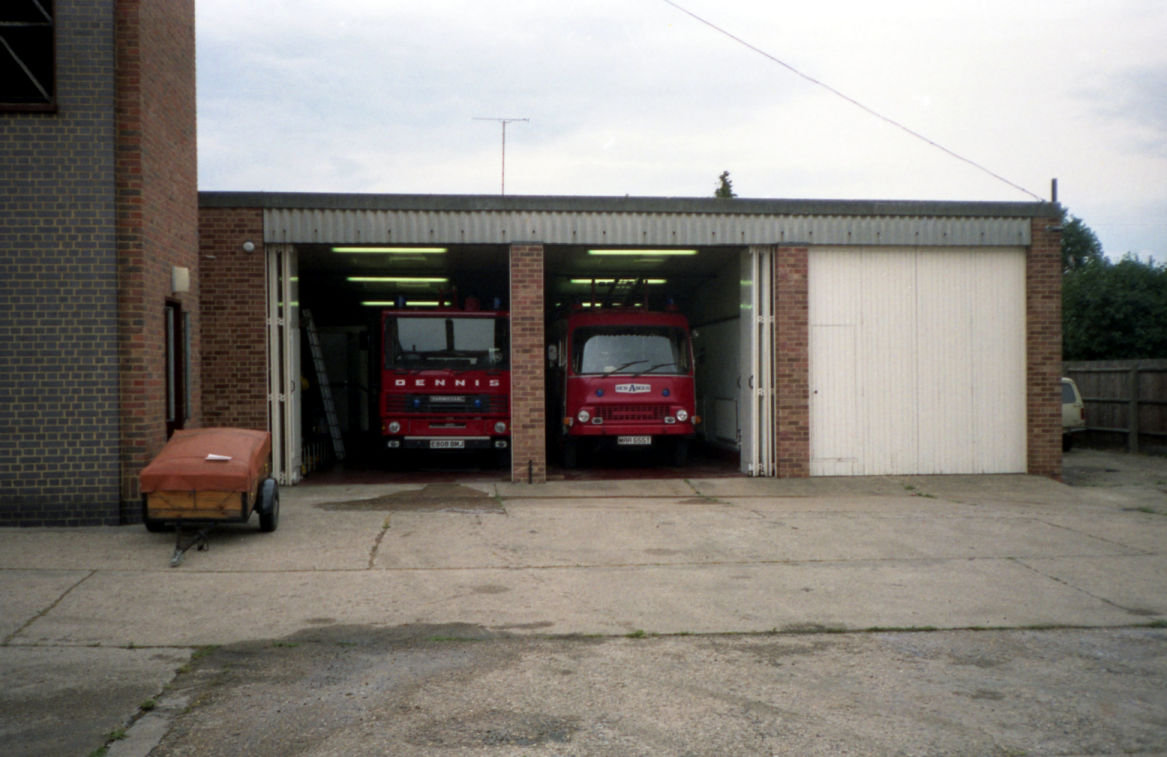
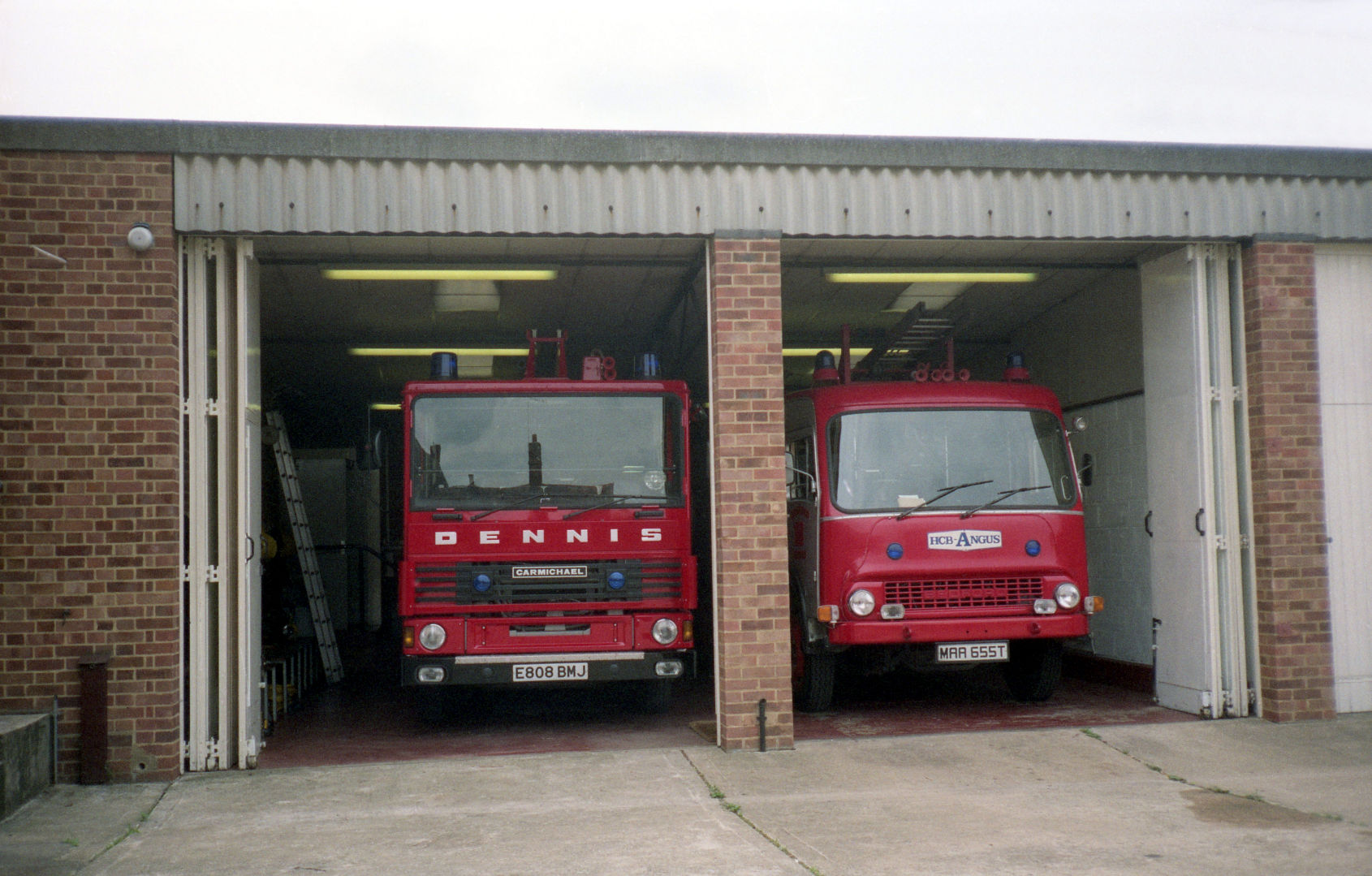
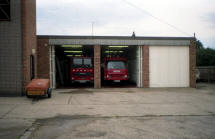
Two shots of the new fire station in
Station Road that shows the full width of
the bays available - photo taken in around
1988-1990. Two appliances housed at the time
are Dennis
E808
BMJ and HCB Angus MAA655T. The
trailer pictured was parked temporarily for
a few days and belonged to one of brigade
members - the paper notice to that effect is
fastened to the canvas cover.
Photo taken and provided
(June 2021) by Andy Ballisat. |
| |
|
|
|
|
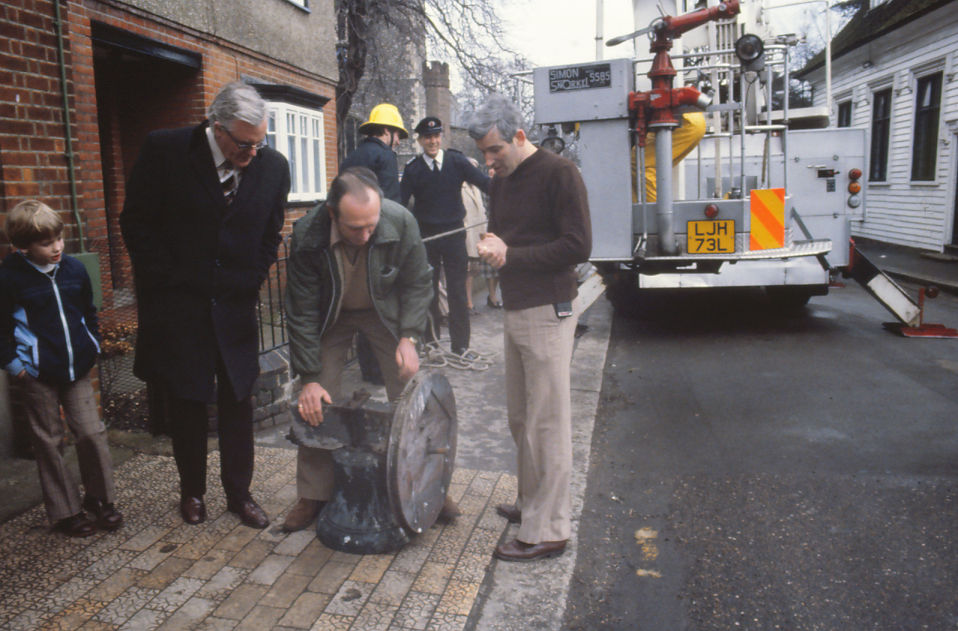
THE MOVE FROM OLD to NEW in March 1981 |
Articles from the Herts & Essex Observer Newspaper
(With acknowledgement to Joy Marshall for the copies) |
| Past and Present as seen in 1981 -
PDF
Download |
The 'New Home' Move -
PDF
Download
(Both pdf's have been
captured in A3 size - Printed Out they will reveal better detail! ) |
|
|
|