|
|
 |
|
Note: All
of the pictures displayed on this page can be enlarged by
clicking the picture itself. If you have Internet Explorer version
6.0 or later you can also save, print, email or further enlarge the picture
from its initial enlarging. |
|
| Print
this page |
| You are
free to save, print or email the pictures. |
|
Sawbridgeworth Fire Brigade - Call Out |
|
Page last updated:
02/07/2020 |
| Calling the Fire Brigade. |
| Paragraph Headings on this page: |
|
The Early Days. |
|
No records are available to identify what happened when a
fire was discovered prior to 1897 or indeed prior to 1902, but it is clear from the Minutes of
the General Meeting of the Brigade on the18th November 1902 that prior to
the dedicated fire station in Church Street coming into use in 1906, the
bell mounted on the front of St. Mary's Church steeple was to be tolled by the
Church Sexton. At the same meeting it was agreed that Mr. Peter Taylor
should send a Messenger on horseback to each of the firemen's residences. Although nothing
has been established in writing it is generally understood
that the fire engine, as well as the horses, were 'stabled' at the King
William IV public house in Vantorts Road. The fire engine was undoubtedly a
'Manual Pump', but more of that on the Fire
Engines page. Back on the 13th January 1902 the A.G.M. of the Brigade
had suggested that wall-plates with the word "Fireman" should be provided
and fitted to fireman's residences. However, this subject came up again on
the 19th January 1905 with the Council being asked to supply them. This must
have been implemented at some time as I recall my Father having one in his
possession but unfixed to the house!
|
 |
A 'pencil' sketch of
The King William IV Public House in Vantorts Road, just 75 yards from
the 'new' Fire Station in Church Street. It is believed that the horses
used had a dual role, that of pulling the hearse for funerals and the
fire engine. What happened if there was a fire call during a funeral has
not been determined! |
|
The 'new' Fire Station was provided with a bell tower
complete with bell. The bell, of course, needed someone to toll it and
undoubtedly this was a known local (local to the fire station) person. The
earliest I am aware of is the Butcher in The Square, Gerald Kirkby and
afterwards and for many years, Mr. Edward (Ted), Morris, Orsman of the Bakery,
3 Church Street (1877 - 1966). It has never been made clear as
to how contact was made with these shop keepers other than that it was
presumably 'Local Knowledge' as far as people in Sawbridgeworth were
concerned! Additionally one can only assume that outside of the town, and
from other towns when assistance was required, messengers on horseback or
cycles would have been used. Perhaps there was a shop window notice "You can
call the Fire Brigade from here"? The Minute Book referred to earlier only
refers in one instance to calling Fireman to the Fire Station and this
related to the duties of Messengers having responsibility to go to the
Fireman's house if he had not responded to the Fire Bell. It is fairly clear
that from the start of the new fire station and for many years to come the
Fire Bell was the main method of call-out.
|
|
The War Years. |
|
There was also an 'additional' call out in the early part
of the war, particularly the period of the London Blitz of 1940. Every time
the Red Alert Siren sounded the Firemen were expected to get to the fire
station quickly and remain on standby until the All Clear. During the war I
was at school at the Fawbert And Barnard and can well remember seeing my
Father (Frank Wright) running up the twitchall (Pathway) that is between The
Forebury and St. Mary's Church Yard several times a day. He was employed at
the part of the Maltings of H.A. & D. Taylor, known as The British Diamalt
Company and I was on my way to the School Dugouts in The Forebury, where the
Memorial Hall stands today, with my class. This arrangement of call-out did
not last very long because there were just too many false alarms!
|
|
Changes were made. |
|
The first mention of a change to the system was in 1939,
when in the Minutes of the Meeting held on the 13th January that year it was
suggested that the Council be asked - amongst other things - to consider the
desirability of installing electric bells in the houses of firemen. As far
as I can recall this did not actually take place until the penultimate year
of the war (1944) at a time when it was thought that Air Raids were more
unlikely. As it turned out air raids became more prolific for a time by
Germany pounding England with the V1 Flying Bomb and later the V2 Rocket, in
that year. There were
one or
two close encounters with
both!
|
|
The First Electronics. |
|
The House Bells, as they were known, were fitted to each
fireman's house, and maintained by the then G.P.O. (General Post Office).
This was the days when most house telephones were connected by wires above
ground with two wires from the telephone pole insulated by porcelain cups.
It was significantly a Fireman's house when a single wire went to the house,
often from a porcelain cup mounted on the very top of the pole!
|
 |
The familiar site
of an insulator 'top-of-pole' with one wire only to a premises usually
indicated that a local fireman resided there! |
|
|
The Bells
were energised by a hand generator and switches, on the side wall and
adjacent to the Rope Pull of the Fire Bell situated in the South West corner
of the Fire Station. In fact I believe the generator etc. was originally
placed on the front wall but were moved later to the position mentioned when
additional alterations were made. The bells were connected by the use of 2
circuits, each circuit having a check bell of its own in the Fire Station. I
believe that two circuits were really required on account of the voltage
drop which would have occurred if all bells required would have been
connected to one circuit. However, the additional value of the split was to
cover for an emergency of one circuit not working: at least one would ring!
The voltage generated was 50v.dc (see Addendum below). The circuits were switched manually by a
brass surface mounted change-over switch of the pendulum type. This
technical necessity of two circuits was often raised as an issue because
some firemen would get the call before others! In the days of the Fire Bell,
at night (after dark) the House Bells were always rung (twice) first and the
Fire Bell used at the discretion of the ringer subject to the time of night.
In the day time the Fire Bell was always tolled first, followed after a
minute or so by the House bells being rung, again twice. Always though one
ring on one circuit then on the other, then again: the duration of each ring
was about 2 Minute each time. The
fire bell itself remained being rung until sufficient men had arrived at the
Fire Station.

GPO Bell Set 26 |
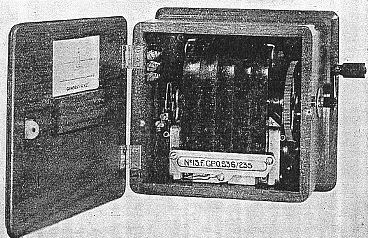
GPO Generator No. 13FN |
Far left, the 'House
Bells' unit, were the standard GPO black Bakelite unit with
clapper in the middle of the two bells and was the same from
the beginning only becoming redundant after radio bleepers
took over in 1971. (More recent information below)
Left shows an example of a
GPO AC Generator that could have been used in conjunction
with House Bells. |
|
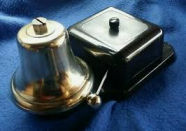
GPO Bell 40B |
Addendum
01/07/2020: The Webmaster's
initial research indicated that the Generation of the voltage was Direct
Current (DC) however the mention of House Bells on this page sparked the
interest of an ex GPO Engineer based in Northamptonshire who worked on
that counties Fire Brigade Call Out System. It seems that the systems
were mostly operated on Direct Current using the GPO Bell 40B. However
the style of that used at Sawbridgeworth indicates that these operated
on Alternating Current (AC) and were GPO Bell Set 26. His further
research along with ex GPO colleagues established that some of the
early GPO systems did indeed use bells of that Alternating Current (AC)
type. This is good evidence that Sawbridgeworth was equipped with house
bells at possibly as early as 1939/1940 as indicated by the SFB Minutes
of the 13th January 1939 and not towards the end of WWII as had
previously been assumed!
The webmaster is indebted to Chris Middleton & his
colleagues for the research and
information provided. |
|
|
Mains Electrics. |
|
The method of call-out mentioned above was continued
until the new Electric Siren was placed on the Hose or Drill Tower in 1947-8
and this purely took over from the Fire Bell. Its sounding was a continuous
'note' as with the war time All Clear. At this time the method of calling
for the fire brigade was updated to make more use of the telephone system
that the general public were becoming more accustomed to! By this time, Mr.
Orsman, the Baker, was now the principal contact for all fire calls and any member
of the public who called the Fire Brigade via the Sawbridgeworth (manual)
telephone exchange would have been put through to Mr. Orsman who would have
taken the details of the type of fire and the address. He would then rush to
the Fire Station and sound the alarm. This was nothing new of course, he had
by this time been doing this for years - what was new, was that more calls
were being made by telephone instead of by 'runner' and there was a button
to press instead of the bell to pull! As with every fireman, he was of
course issued with a key to the Station door, which in those days was just one
of a three stage folding door set that reached to the height of the bottom of
the arched front. Above the doors was a non opening glass panelled arched
wooden frame also of three panels. Later on these doors were to be completely
replaced by three full height folding doors that fitted to the arch, the
left hand door having a small pedestrian entry door within it. |
|
Improved Efficiency. |
|
This much noisier method of alerting the Firemen during
the day time and until around 10pm at night was much more efficient - the
siren was fitted with a timer to prevent it sounding during the night. The Fire
Bell was beginning to loose its ability to be heard because the 'world' was
already becoming a noisier place and of course Sawbridgeworth was expanding
and men were working further from the centre in many cases. The electric
siren was also fitted with an electric period timer mechanism which
originally was set to three quarters of a minute. There were numerous
complaints about this because on several occasions men based at both Walter
Lawrence Joinery Works and the Maltings failed to hear the call-out over the
sound of machinery. The length of sounding was subsequently increased to a
minute and a half. It seems almost unbelievable but on many occasions during
evening time a full crew had arrived at the Fire Station (5 men) before the
siren had finished sounding and it was often turned off at the main switch
to prevent the 'awakening of the town' any longer! On one occasion the main
switch was left off inadvertently and the siren did not sound for a
subsequent fire call - it was
fortunate that this was evening time and the house bells done their job! The
Siren was apparently withdrawn from use on the 17th September 1971 and
replaced by the issue of bleepers (Alerters) to firemen, which they were expected to
carry at all times. The Log Book of 1971 indicates that House Bells remained
in operation at this time.
|
|
Remote Call-Out. |
It was probably not until the early 1950's that the
system was updated further. This was quite a significant change because it
was based on all telephone calls for a fire being diverted to Bishop's
Stortford Fire Station. By this time telephones in Sawbridgeworth and the
surrounding district had been converted to automatic dialling via the small
and new telephone exchange building off the very narrow Bull Fields road
close to its junction with Station Road. This of course was the first
provision of the 999 system in the area which allowed filtering of the calls
and direction as required. Also by this time Bishop's Stortford Fire Brigade
had become part full time but, only with two personnel on duty at any
time, day and night. The system for call-out at Sawbridgeworth was now
altered to fully automatic with the 'pressing of the button' being done at
Bishop's Stortford: this was via a direct telephone line link between both
fire stations. (The same arrangement was installed for Much Hadham). The new
arrangement also automated the ringing of the bells in the Firemen's houses
but now they rang 13 times of about 5 seconds duration instead of twice -
and both circuits together! The ringing period was of the same duration as
the siren and there was a very distinctive 'first ring' which was very short
in comparison with the remainder. These two known features were used for
timing in 'our' house. At night and in bed asleep, you needed to be out of
bed and dressed by the third ring and out of the house by the time the bells
had rung their course, i.e. one and a half minutes! Otherwise there
was every possibility you would 'miss the pump', as it was known. This meant
that at dead of night the 'turn-out' (pump left the station with full crew)
was usually achieved within four to four and a half
minutes (#). Everything personal needed was of course meticulously laid ready for
achieving this and the Brigade had an excellent record of turn-out times
over a very long period of years. This revised system of call-out also
brought the problem of the first fireman arriving at the Fire Station,
particularly at night, and no one already there - he had to have his door
key! I think it happened only once that there was a short wait until a key
holder arrived but this was overcome by the placing of a door key on a piece
of string inside the letter box and this remained the procedure for some
years. I suspect it would not be possible to rely on such a basic
arrangement today for fear of vandalism!
(#) It would be remiss
here not to mention one of the shopkeepers of Church Street who assisted the
brigade in its turnout achievements over many years after the time of Ted
Orsman the baker! Next door to the baker's premises (nearer the fire
station) was a cobblers run by the Blake family. The son of the cobbler was
Harold Leslie Blake (1912 - 2008) who took a real interest on assisting with turnouts. As soon as
the siren was heard he would go and, using the letterbox key, open the full
doors so that access for arriving firemen was immediate. He also took a
great interest in the incidents themselves and took many photographs,
unfortunately most of his slides were unrecorded as to where the incident
took place but some were obvious as
shown by those taken of the destruction of
Burton's Mill in Station Road. |
| ========================================= oooooooo========================================= |
| Alerters |
Information kindly provided by Simon
Lincoln - Hertfordshire Fire & Rescue Updated 02/06/2o20 |
|
|
|
The Pagers were, and still
are, known in the Fire Brigade as Alerters. The radio signal to sound the
alerters, and call the crew, is transmitted from equipment installed at the
fire station. This transmitter is operated remotely by Fire Service Control,
using primary, secondary or tertiary barriers, each one using a different
method of triggering the station end equipment. |
|
|
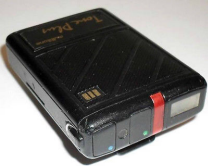 |
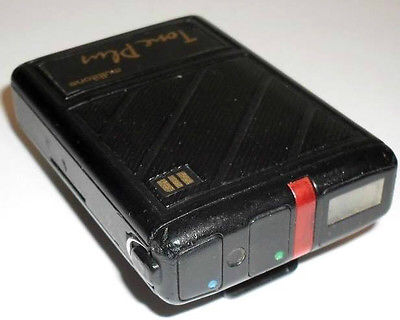
Multitone Tone
Plus 412 alerter mid 1980's - 2006
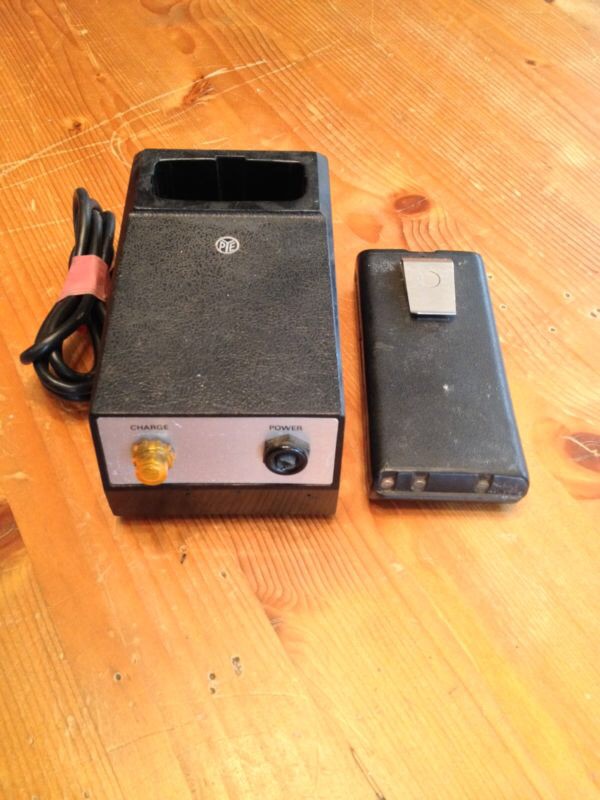
The Multitone Tone Plus 412 were
about quarter of the size of the previous Pye models and was
powered by an AA battery (HP7 at the time). It had a sprung
loaded belt clip and a clip on lanyard to secure to trousers.
Units had a red light, that flashed when operated and was used
with 2 separate tones. Each tone sounded 4 times for
approximately 10 seconds with 5 second pause between. One tone
was for a operational call, the other was the weekly test, this
sounded on a Tuesday evening at approximately 18:35. Each tone
could be muted, but this had to be done for every 10 second
burst! LCD display displayed a number from 1-4, each number
indicating the type of call received along with a distinctive
tone for each, i.e. a fire call or test etc. received. This display
could be reset by pressing of buttons on top of unit, or could
be turned off by pressing the small round recessed button in
between the 2 larger ones. |
|
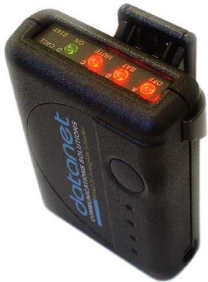 |
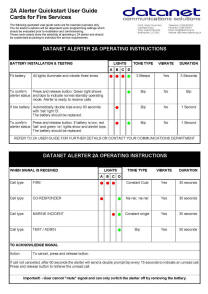 |
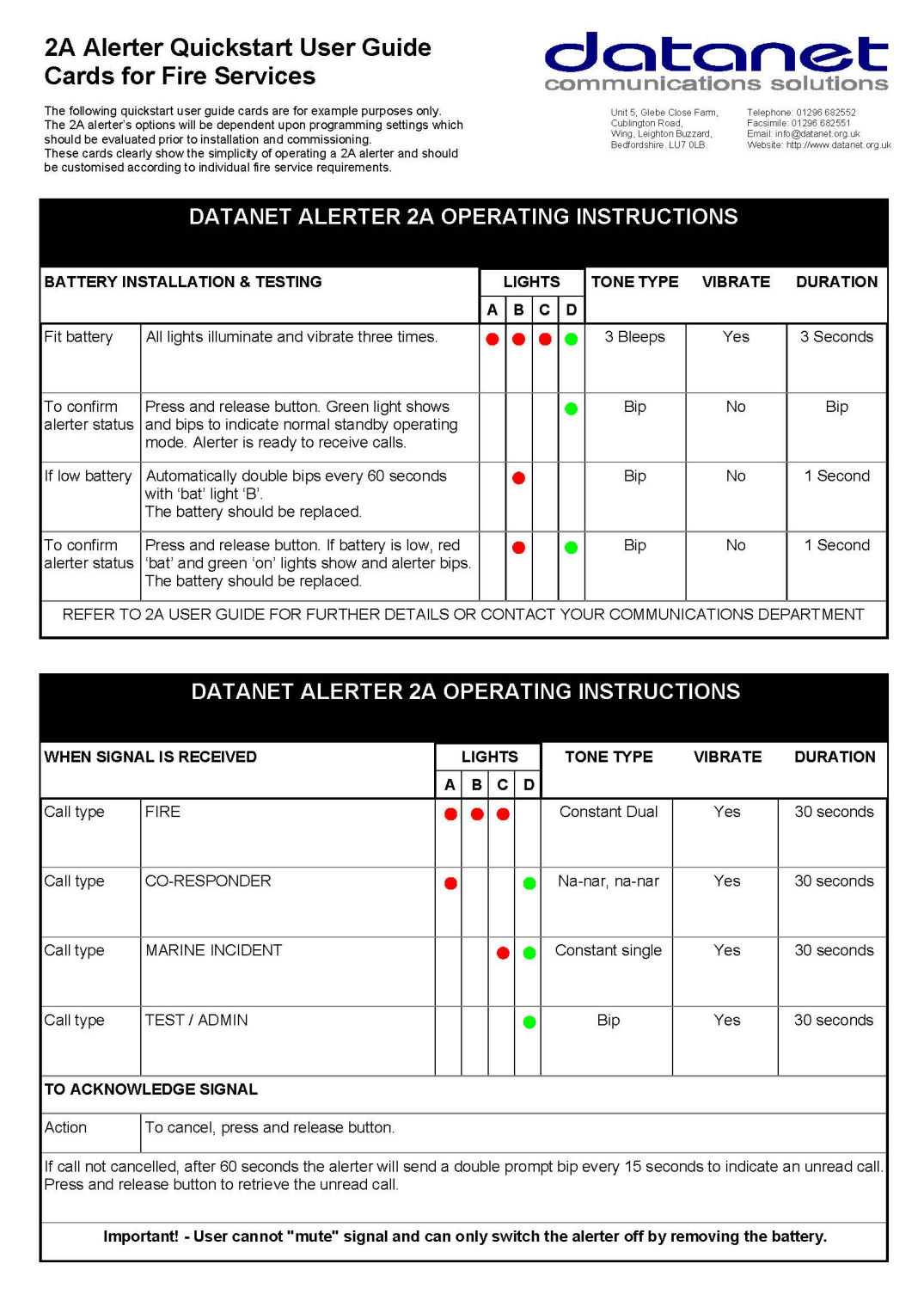
Datanet 2A alerter 2006 -
01/06/2020
Similar size units to the Multitones, powered by an
AA battery. Again it also has sprung loaded belt clip and
lanyard. 4 LED lights on the unit, 3 red and 1 green and 2 tones
still used. During activation for operational call all 3 red
LEDS flash and a dual constant tone sounds for approximately 30
seconds along with a vibration function. If the unit is not
muted/reset by pressing button on side, after a minute the green
LED flashes every 15 seconds along with a bleep indicating a missed
call. Following a missed call, once the button on side is
pressed, the alerters will resound the last signal received
(either and operational call or test 30 second bip bip tone)
These are the current items in service.
Onwards:
Currently various options are being investigated in
the way forwards to alert fire-fighters. Smart alerters with a
function to enable acknowledgement of your attendance or mobile
phone app paging functions using a multi-network SIM card to
name a few. The Emergency Services Network (ESN) trial due to
start in 2019, could bring newer technology with regard paging
and alerting systems, across the wider emergency services. |
| |
Copyright,
Trademarks or Registered Designs are acknowledged |
|
|
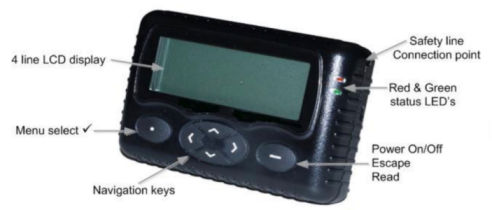 |
Birdy Multitone WP 02/06/2020 - Present day
Slightly
larger than the Datanet 2A, due to the fact
it has a 4 line LCD screen that can display
call information. Again powered by an AA
battery and it has a sprung loaded belt clip
and lanyard. 2 LED lights on the unit and 2
tones still used. During activation for
operational call the red LED flash, screen
lights up red displaying Sawbridgeworth Fire
Call and a dual constant tone sounds for
approximately 30 seconds along with a
vibration function. The unit has an unread
message alert that after 1 minute the unit
resounds indicating a missed call. It also
has some user adjustable settings (font
size, vibrate and or tone or silent setting,
alarm clock, battery level notification
(with a night time low battery mute)) Screen
colours vary too, Red for Fire call, Green
for Test call and Blue for Menu functions.
IP67 dust and waterproof making it more
robust to contamination. |
|
|
|
|
|
|
|

 |
|
|
|
|